

Designing the Sustainable Streets of the Future
Not got time to read? Listen instead with our audio version
he UK’s transition to electric vehicles is no longer a distant ambition — it is a present-day reality. With petrol and diesel phase-out targets approaching and EV adoption accelerating, towns and cities are under increasing pressure to rethink infrastructure at street level.
Urban planning and EV charging are now inseparable. The challenge is no longer whether to install charging infrastructure — it is how to integrate it intelligently, attractively, and sustainably into the urban fabric.
From high street regeneration to smart city development and dual-purpose streetlighting, forward-thinking authorities and developers are reshaping streets for the electric era.
Integrating EV Charging into Town Centres & High Streets
Town centres across the UK are evolving. Retail patterns are changing, mixed-use developments are increasing, and councils are actively investing in regeneration strategies to revitalise footfall and economic activity.
EV charging infrastructure can play a powerful role in this transformation
Supporting Local Businesses
Drivers typically spend 30 minutes to several hours at destination chargers. When positioned in town centres and high streets, chargers encourage drivers to shop, dine, or access services while their vehicle charges. This creates natural dwell time — benefiting local economies.
For businesses, EV charging becomes an amenity that attracts and retains customers.
Minimising Visual Impact
Urban areas often face space constraints and aesthetic considerations, particularly in heritage zones. Bulky standalone charging units can add clutter and resistance from planning authorities.
Integrated, compact, and multi-use solutions help preserve the visual character of high streets while still delivering essential infrastructure.
Accessibility & Inclusivity
Urban charging must be accessible to all users — including disabled drivers and residents without off-street parking. Kerbside solutions and evenly distributed infrastructure are essential to prevent a two-tier EV transition.
Strategic placement matters as much as charger speed or specification.
Charging Infrastructure for Cities of the Future
The cities of tomorrow will be connected, data-driven, and energy-aware. EV charging must form part of this wider ecosystem rather than exist as isolated hardware installations.
Smart Energy & Load Management
Urban areas often experience grid constraints. Smart load management systems allow multiple chargers to operate efficiently within available capacity, distributing power dynamically and avoiding costly grid upgrades.
This makes scaling possible without overwhelming local networks.
Data-Led Urban Planning
Modern EV infrastructure generates valuable usage data — peak demand times, dwell durations, charging behaviours. When analysed responsibly, this data can inform:
- Future charger placement
- Urban traffic planning
- Energy demand forecasting
- Parking policy decisions
- Public transport hubs
- Park-and-ride schemes
- Car-sharing services
- Active travel infrastructure
Data-driven planning ensures investment goes where it delivers maximum impact.
Integrated Transport Ecosystems
EV charging should complement broader sustainable transport initiatives, including:
- Public transport hubs
- Park-and-ride schemes
- Car-sharing services
- Active travel infrastructure
The goal is not just electrification, but holistic mobility planning.
Sustainable Streets: Combining Streetlighting & EV Charging
One of the biggest challenges in local authority EV charging is supporting residents without driveways.
Over 40% of UK households rely on on-street parking. Without kerbside EV charging UK solutions, these residents may be excluded from the transition to electric vehicles.
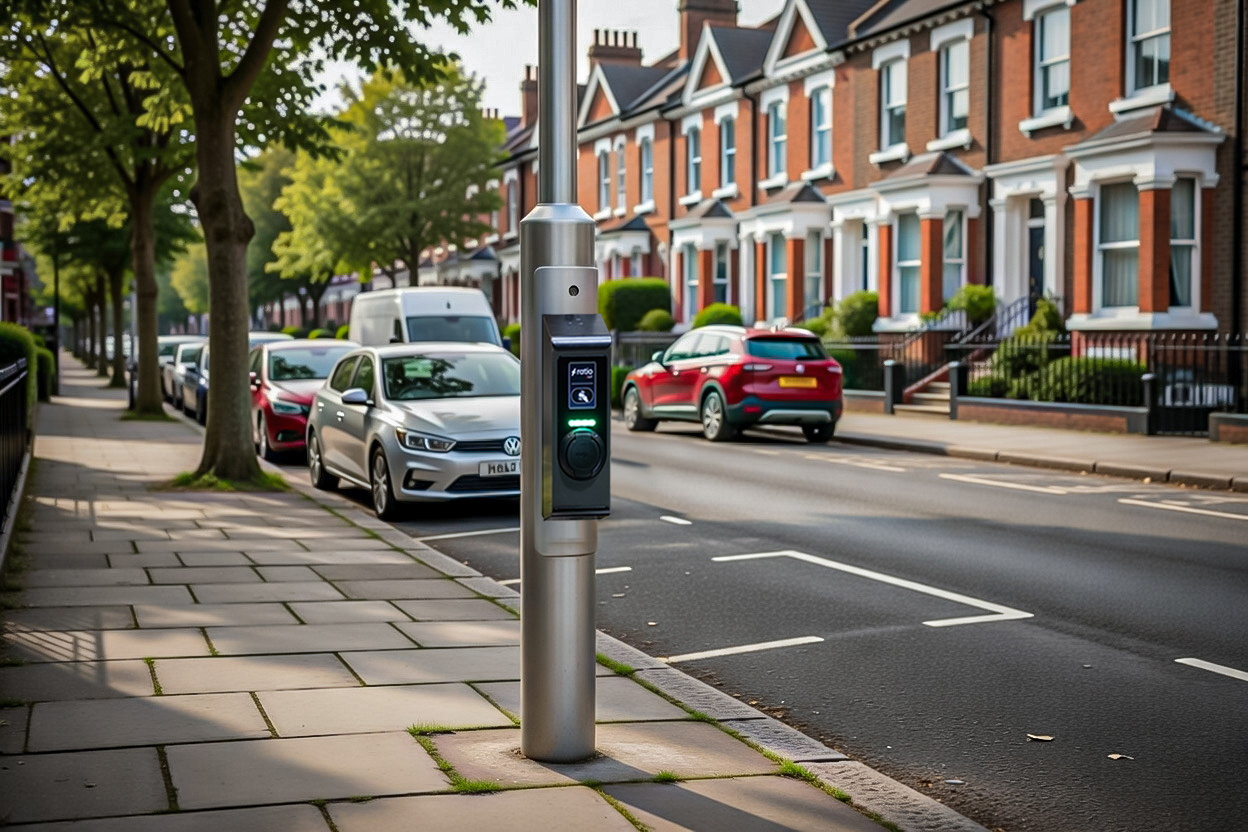
One of the most innovative approaches to urban charging is dual-use infrastructure — particularly combining streetlighting columns with EV charging capabilities.
Why It Works: Streetlighting columns already have:
- Existing power connections
- Established pavement positions
- Regular spacing along residential streets
- Residential streets lacking driveways
- Mixed-use neighbourhoods
- Dense urban areas where pavement space is limited
- Conservation areas requiring subtle installations
- Reduced installation costs
- Minimal excavation
- Lower material usage
- Faster deployment times
By upgrading or integrating charging technology into these assets, local authorities can deploy infrastructure without additional street clutter or extensive civil works.
Ideal Applications This approach supports residents who rely on on-street parking — a critical factor in urban EV adoption. Although residents may not have driveways, there will be easily accessible lamp posts which can provide up to 5kW - perfect for overnight charging.
Environmental & Financial Benefits Dual-use infrastructure aligns with sustainability goals while delivering practical results.
How the Ratio io6 Street Supports Urban Deployment
The Ratio io6 Street has been developed with local authority requirements in mind.
Designed for street-level installation, it offers:
- A compact footprint suited to urban and residential environments
- Integration capabilities with existing street infrastructure
- Smart charging functionality to optimise grid usage
- Durable construction appropriate for public realm deployment
- Scalable installation options to support phased rollouts
By enabling kerbside charging without excessive street clutter, the io6 Street helps councils balance accessibility, aesthetics, and long-term infrastructure planning.
Key Challenges — and How to Address Them
Grid Capacity
Urban substations may not support rapid large-scale deployment. Smart charging, phased rollouts, and energy storage integration can mitigate this.
Planning & Heritage Restrictions
Early engagement with planning departments and conservation officers ensures solutions respect architectural character while meeting modern demands.
Funding & ROI
Blended funding models — combining public investment, private partnerships, and grant schemes — can accelerate rollout while ensuring long-term viability.
Public Engagement
Clear communication with residents builds support and reduces resistance. Demonstrating community benefit is essential.
The Strategic Opportunity
EV charging is no longer simply a transport upgrade — it is civic infrastructure. Just as streetlighting, broadband, and public transport once reshaped urban life, charging networks will define the usability and attractiveness of towns and cities in the electric age.
Urban planners, developers, and local authorities who act early can:
- Support economic regeneration
- Enable equitable EV access
- Strengthen sustainability commitments
- Future-proof their communities
Designing sustainable streets requires foresight, integration, and the right technology partnerships.
The question is no longer whether cities will adapt — but how intelligently they do so.
Discover how the Ratio io6 Street can support your urban charging strategy and help deliver scalable, street-ready infrastructure.
Visit Ratio EV to learn more or speak with our team about supporting your next deployment project.
Find out more about the io6 Street
Related Articles

Built to Last: The Durability and Weather Resistance of Modern EV Charging Stations
Imagine a charging station that can withstand the full force of a British winter - from driving...
Read more
A Guide to Static vs Dynamic Load Management in EV Charging
In the rapidly evolving landscape of electric vehicles (EVs), managing the power demands of...
Read more-web.jpg?width=352&name=Exterior_Final-(4)-web.jpg)
Why EV Charging is Becoming a Revenue Generator for Leisure and Retail Destinations
Electric vehicle adoption is accelerating across the UK, and with it comes a growing expectation...
Read more